Building the cloud computer with Oxide Computer Company
Oxide Computer Company secured $222.5 million in Series D funding to expand its rack-scale cloud computer designed for on-premises use. The system provides 2,048 CPU cores per rack and offers a high-efficiency alternative to public cloud providers for enterprises.


Oxide Computer Company secured $222.5 million in Series D funding on July 20, 2026. This investment brings the company valuation to $5.8 billion. Steve Tuck and Bryan Cantrill founded the company in 2019. They build a rack-scale cloud computer for on-premises use. The company employs 62 people and generates $15.1 million in revenue. I find their focus on avoiding public cloud dependency logical.
The company targets enterprises that need control over security, latency, or regulation, which often struggle to match the flexibility of cloud resources when they use retail servers from companies like Dell, HPE, or Lenovo. These users often find that public clouds impose high costs and vendor lock-in. Oxide provides a system that integrates hardware and software to manage multitenancy. This setup allows users to provision infrastructure through a web console. The product uses a custom hypervisor for multitenancy. Customers like Idaho National Laboratory and a global financial services firm already use the system.
The funding history shows steady growth. In February 2026, Oxide raised $100 million in Series C funding. This followed a $110 million raise in July 2025, which included $100 million in Series B-1 and $10 million in Series B-2. Investors like Counterpart Ventures, Eclipse Ventures, Intel Capital, Rally Ventures, Riot Ventures, and the Us Innovative Technology Fund participated in these rounds. Earlier, the company raised $57.17 million across Series A and A-1 in October 2023.
Engineering from the ground up
The engineering team avoids traditional reference designs. Most electrical engineers use Field Applications Engineers to get voltage regulator designs, but Oxide hires people who understand the actual design. Bryan Cantrill previously worked at Joyent and Sun Microsystems. He and Tuck aim to bring hyperscale cloud benefits to private data centers. Some engineers joined from GE Medical, where they worked on CT systems.
They build everything.
Richard Dresden joined the team as SVP of Sales and Field Operations. He joins a remote-first workforce. The team includes experts from companies such as Meta, Amazon, and Google. They use uniform compensation and avoid salary negotiations.
Oxide delivers hardware.
The company maintains transparency through the Oxide and Friends podcast. This culture helps them build a team that lasts. They recruit people based on curiosity and written reflections.
The hardware reality
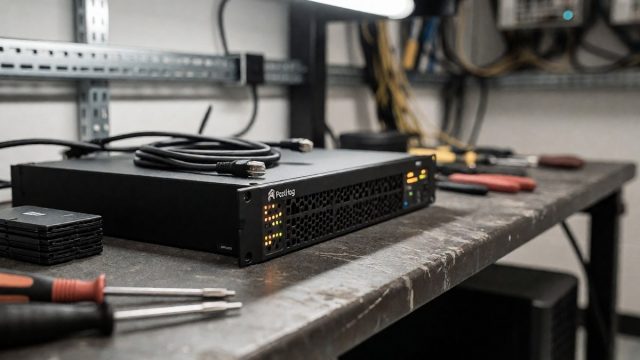
The Cloud Computer cabinet resembles a large industrial refrigerator. It holds up to 32 sleds. Each sled uses one AMD EPYC 7713p processor. The system provides 2,048 CPU cores per rack.
| Feature | Specification |
|---|---|
| Max Sleds | 32 |
| Base Model Sleds | 16 |
| Processor | AMD EPYC 7713p |
| Total CPU Cores | 2,048 |
| Memory per Sled | 512GB or 1TB |
| Total Rack Memory | 16-32TB |
| Total Rack Storage | 1PB |
A single rack occupies 33% less space than a traditional rack. It uses 35% less power than traditional racks with AC power supplies. Installation takes less than a day because the unit arrives fully assembled. You should look at the efficiency gains before you commit your budget to this. A computer with 32 sleds costs less than an equivalent rack from Dell, which would cost $2.3 million. Each sled provides 64 cores, 32TB of storage, and up to 1TB of memory. The system provides 12x better cooling than standard options.
The hardware features custom-designed networking hardware integrated into the back of the cabinet. This networking hardware facilitates the deployment of new sleds. Sleds can be added or removed on the fly to increase or decrease computing capacity.
Will the company add GPUs to the sleds soon?

Technewsdaily
Senior tech writer covering AI, gadgets and cybersecurity. Breaking down the news that matters, every day.